

Self-employed in Quebec: the forms, contributions and deadlines behind your return
What a Quebec sole proprietor files (T2125, Schedule L, TP-80-V), when it is due, the QPP and QPIP owed on profit, instalments and home-office rules.
Sources: Revenu Québec, Canada Revenue AgencyLast reviewed View sources
Next step
Ready to act on this guide?
Read more articles on this topic, or go to the matching service page when you are ready to act on what you have just read.
Working for yourself in Quebec means two business schedules, pension and parental-insurance contributions calculated on your own profit, and sometimes tax paid before the year ends. This guide takes those obligations in the order they come up. Figures are for the 2025 tax year (returns filed in 2026) unless a line says otherwise; each one was checked against the official pages listed at the end on September 27, 2026.
Where your business income is reported
Federally, ordinary business or professional income is reported on Form T2125 with the T1 return. Farming and fishing use their own forms.
On the Quebec return, Schedule L separates gross business income from net income or loss. Accrual accounting is the general rule; farmers, fishers and commission earners have cash-method exceptions. Attach financial statements or TP-80-V for each ordinary business. Farming and fishing instead use the applicable TP-80.AP-V information.
Two more Quebec rules shape the numbers:
- Fiscal period. A sole proprietorship normally reports on a fiscal period ending December 31. A business with another year-end completes form TP-80.1-V to adjust its income to December 31.
- Losses. When a business loss is larger than your income from other sources, the balance can reduce your income of the previous three years (form TP-1012.A-V, filed separately) or, in most cases, of the next twenty years.
Filing date versus payment date
- Filing: the ordinary 2025 deadline was June 15, 2026 if you or your spouse operated a business. CRA has an April 30 exception for businesses whose expenses mainly concern tax-shelter investments; deceased-person cases also have separate rules.
- Payment: the ordinary 2025 balance was due April 30, 2026 federally and provincially. Interest begins after the payment deadline, even when the filing deadline is later.
- Revenu Québec moves a deadline that falls on a Saturday or Sunday to the next business day.
The practical consequence: estimate your profit in April so the balance, the QPP contribution and the QPIP premium are paid on time, then use the extra six weeks for the filing itself.
The contributions your profit pays
Revenu Québec publishes combined rates for self-employed people, who pay both the employee and employer shares of the Quebec Pension Plan (QPP):
- 2025: a basic rate of 10.8% plus a first additional rate of 2%, with maximum pensionable earnings of $71,300. The same page lists a second additional rate of 8% on the band between $71,300 and the additional maximum of $81,200.
- 2026: a basic rate of 10.6% plus a first additional rate of 2%, with maximum pensionable earnings of $74,600 and an additional maximum of $85,000 (second additional rate 8%).
These rates apply to pensionable earnings, not gross sales. The basic exemption is $3,500; age and employment contributions can change the calculation.
Most self-employed people calculate the contribution in Part C of Schedule U. If you also reported employment income on line 96, 96.1 or 96.2, Revenu Québec uses form LE-35-V instead, which you keep rather than send. Since January 1, 2024, a worker aged 65 or older who receives a QPP or CPP retirement pension can choose to stop contributing, and workers over 72 no longer contribute at all.
Schedule R calculates the Québec parental insurance plan (QPIP) premium. The under-$2,000 exemption considers net business income, QPIP employment income and any applicable insurable family-type or intermediate-resource earnings. QPIP already paid through employment also affects the calculation.
Instalments: the $1,800 test
Revenu Québec requires instalments when estimated current-year net income tax payable exceeds $1,800 and the amount exceeded $1,800 in either of the two previous years. Farmers and fishers need the current-year test and both prior years. Instalments can also cover QPP, QPIP, health services fund contributions and prescription-drug-plan premiums.
The CRA has a separate instalment test: for Quebec residents, the $1,800 federal net-tax-owing threshold considers the current year and either of the two preceding years. Check each agency independently; do not add the two balances together to test one threshold.
Federal home-office eligibility
The CRA allows business-use-of-home expenses only when the workspace is either:
- your principal place of business; or
- used only to earn business income and used regularly and continuously to meet clients, customers or patients.
The claim cannot create or increase a business loss; the part above your net income before these expenses carries forward to the next year under the same conditions. Split shared costs by floor area (office square footage over the home's), and for a room also used personally, by the share of hours it serves the business.
Sales taxes follow their own calendar
GST and QST have separate registration and reporting rules. The loss-of-small-supplier date depends on crossing $30,000 in one quarter or over consecutive quarters, with activity-specific exceptions. Check collection and registration dates in our GST/QST guide, rather than applying an income-tax deadline to sales taxes.
A hypothetical mixed-income file
Suppose an employee also invoices freelance clients. The T4/RL-1 does not replace the business ledger: keep the freelance invoices and expenses separate, then supply employment slips so the contribution calculations can account for amounts already paid. This example illustrates the records needed, not a promised tax result.
Records: six years
The CRA's general rule is to keep records and supporting documents for six years from the end of the last tax year they relate to. For a sole proprietor that covers invoices and deposit records, receipts sorted by category, a vehicle logbook if you claim the car (how to keep one), the measurements behind a home-office claim and your instalment receipts.
Late-filed returns require six years of supporting records from filing; property history, disputes and specific retention requests may require longer.
Year-end checklist for 2026 income
- Close the books on December 31, 2026 and reconcile invoices against bank deposits and payment-processor statements.
- Separate capital purchases (equipment, computers, vehicles) from current expenses before anything else.
- Estimate 2026 profit early in 2027. Under the ordinary standing rules, April 30, 2027 is the payment planning date and June 15, 2027 the business-filing planning date; confirm exceptions and the official calendar before filing.
- For 2027 instalments, check estimated 2027 tax and the applicable 2025/2026 history. A 2026 amount above $1,800 alone does not settle the result.
- File the six-year archive for 2026 before the busy season starts.
When one file mixes employment, self-employment and rental income, our self-employed tax service lists what TaxCove needs to start.
General information for Quebec residents, not advice on your particular situation.
General information only; this guide does not constitute personalized tax advice.
Official sources used in this article
Every rule, date, and threshold in this guide comes from these official sources.
Last reviewed
- Revenu Québec: line 164, business income (Schedule L, TP-80-V)(opens in a new tab) – Revenu Québec
- Revenu Québec: QPP contribution payable by a self-employed person(opens in a new tab) – Revenu Québec
- Revenu Québec: line 439, QPIP premium on self-employment income(opens in a new tab) – Revenu Québec
- Revenu Québec: instalment payments(opens in a new tab) – Revenu Québec
- Revenu Québec: deadline for filing your income tax return(opens in a new tab) – Revenu Québec
- CRA: important dates for individuals(opens in a new tab) – Canada Revenue Agency
- CRA: business-use-of-home expenses (Form T2125)(opens in a new tab) – Canada Revenue Agency
- CRA: how long to keep your records(opens in a new tab) – Canada Revenue Agency
- CRA: federal instalment eligibility for Quebec residents(opens in a new tab) – Canada Revenue Agency
- CRA: 2025 filing dates and exceptions(opens in a new tab) – Canada Revenue Agency
Next step
Need help with a self-employed tax file?
If this article matches your business income or expense questions, use the self-employed service page to move into the filing process.
Best when income, expenses, vehicle use, home office, or bookkeeping cleanup affects the return.
Preparation resource
Self-employed tax organizer
Organize the records, categories, and preparation steps that usually matter for Quebec self-employed tax files.
Next steps
More guides and services for this topic.
Self-employed
Articles for Quebec freelancers and business owners covering deductible expenses, vehicle logs, GST/QST questions, and filing structure.
Self-employed
Complete tax preparation for self-employed individuals including business income, expenses, and home office deductions
Secure online tax filing
Online tax filing across Quebec with bilingual intake, document handling, and clear next steps.
Related articles
More guides and services for this topic.

Self-employed in Quebec: 2026 filing guide for 2025 business expenses
2026 filing overview of common 2025 business-expense categories for self-employed people in Quebec, with recordkeeping examples.

GST/QST for self-employed workers in Quebec: registration thresholds, timing, and common errors
Practical guide to GST/QST registration thresholds, timing, and common mistakes for self-employed workers in Quebec.
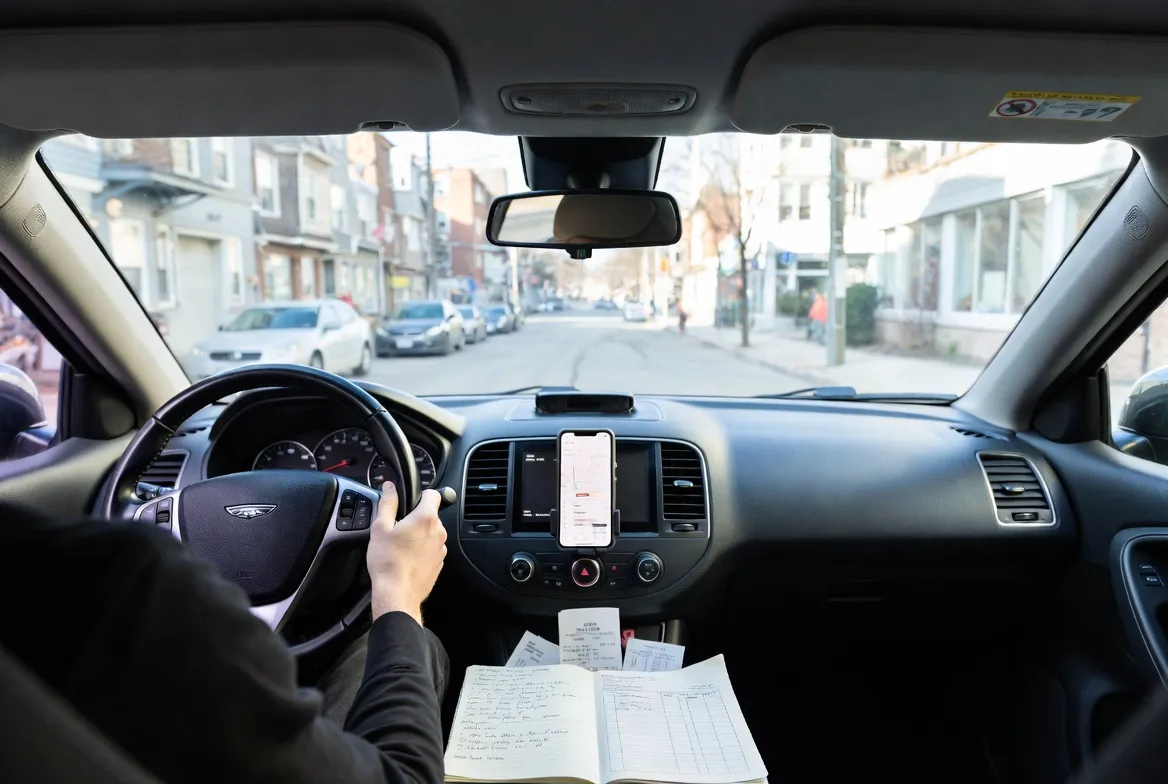
How to track mileage and vehicle expenses correctly as a self-employed worker in Quebec
Simple methods to track mileage and vehicle expenses in Quebec so you can deduct car costs properly as a self-employed worker.