

Self-employed in Quebec: 2026 filing guide for 2025 business expenses
2026 filing overview of common 2025 business-expense categories for self-employed people in Quebec, with recordkeeping examples.
Sources: Canada Revenue Agency, Revenu QuébecLast reviewed View sources
Next step
Ready to act on this guide?
Read more articles on this topic, or go to the matching service page when you are ready to act on what you have just read.
As a self-employed worker in Quebec, it is tempting to deduct as many expenses as possible to reduce your net income on T2125 and TP-80. But not every expense is deductible, and some must be prorated for personal use.
Here is a high-level tour of the main categories for 2025 income being filed in 2026. The examples illustrate recordkeeping and allocation; they do not determine whether a specific cost is deductible in your situation.
Filing status for the 2025 return
The CRA filing deadline for most self-employed people and their spouses or common-law partners was June 15, 2026. Any 2025 balance owing was still due April 30, 2026. If you have not filed, submit the outstanding federal and Quebec returns as soon as practical and check both accounts for notices or balances.
1. Basic rule: expenses to earn business income
Revenu Québec and the CRA require that an expense:
- Be reasonable, and
- Be incurred to earn business or professional income.
Purely personal expenses (regular clothing, groceries, leisure trips) are not deductible.
2. Day-to-day operating expenses
Common expenses for consultants, tradespeople, and professionals include:
- Advertising and marketing: website, business cards, online ads.
- Supplies: paper, toner, small equipment.
- Telecommunications: mobile phone, internet, dedicated lines.
- Software and subscriptions: office suites, invoicing tools, CRM.
- Professional fees: accountant, lawyer, advisory services.
Example
A marketing consultant in Montreal reports for 2025:
- $1,800 in phone/internet (bundled plans).
- $900 in software and professional subscriptions.
- $2,400 in online advertising.
If 70% of phone/internet use is for business, the deductible portion is:
- $1,800 × 70% = $1,260.
- Plus $900 + $2,400 = $4,560 total for these items.
3. Travel and vehicle expenses
Vehicle costs are sensitive in audits. You must:
- Keep a mileage log (opening/closing odometer, total distance, business trips).
- Separate personal trips (groceries, family) from business trips (clients, sites, suppliers).
Deductible expenses (pro-rated for business use) may include:
- Fuel.
- Maintenance and repairs.
- Auto insurance.
- Registration and licence fees.
- Interest on financing or lease payments.
- Business parking.
For more depth, see:
4. Home office
If your home is your main place of business or you regularly meet clients there, a portion of home costs may be deductible:
- Heating and electricity.
- Property taxes and other home costs only where the current rules allow them.
- Home insurance.
- Maintenance (cleaning, small repairs).
The most common allocation key is the area of the office compared with the total living area, adjusted if needed for professional vs personal use.
Note: the home office deduction cannot create or increase a business loss; excess amounts are carried forward.
5. Meals and entertainment
Restaurant meals are generally limited to 50% deductibility and only when directly linked to your business (clients, travel, business meetings).
Example:
- $1,200 in restaurant bills during the year.
- You identify $200 as personal.
- Business portion: $1,000.
- Deductible share: $1,000 × 50% = $500.
6. GST/QST and expenses
If you are registered for GST/QST:
- Separate pre-tax amounts from recoverable taxes on your invoices.
- Correctly claim input tax credits (ITCs) / input tax refunds (ITRs) on eligible expenses in your returns.
For registration thresholds and common mistakes, also see:
7. Capital assets and CCA
Certain large purchases (computer, furniture, equipment, vehicle) are not deducted in full in Year 1. They go into CCA classes and are depreciated over several years.
- Example: a $2,000 laptop purchased in 2025.
- Recorded in the right class; only a percentage is deductible annually.
Need help with your situation?
If you are self-employed in Quebec and unsure how to organize 2025 expenses, TaxCove can review your records and help structure the categories for filing. To get started, complete our online form on the secure tax intake form page.
Important notice: This article provides general information only and does not constitute personalized tax advice. Revenu Québec and CRA rules can change and contain many exceptions. Always validate your tax choices with a professional or directly with the tax authorities.
Official sources used in this article
Every rule, date, and threshold in this guide comes from these official sources.
Last reviewed
Next step
Need help with a self-employed tax file?
If this article matches your business income or expense questions, use the self-employed service page to move into the filing process.
Best when income, expenses, vehicle use, home office, or bookkeeping cleanup affects the return.
Preparation resource
Self-employed tax organizer
Organize the records, categories, and preparation steps that usually matter for Quebec self-employed tax files.
Next steps
More guides and services for this topic.
Self-employed
Articles for Quebec freelancers and business owners covering deductible expenses, vehicle logs, GST/QST questions, and filing structure.
Self-employed
Complete tax preparation for self-employed individuals including business income, expenses, and home office deductions
Secure online tax filing
Online tax filing across Quebec with bilingual intake, document handling, and clear next steps.
Related articles
More guides and services for this topic.

Self-employed in Quebec: the forms, contributions and deadlines behind your return
What a Quebec sole proprietor files (T2125, Schedule L, TP-80-V), when it is due, the QPP and QPIP owed on profit, instalments and home-office rules.

GST/QST for self-employed workers in Quebec: registration thresholds, timing, and common errors
Practical guide to GST/QST registration thresholds, timing, and common mistakes for self-employed workers in Quebec.
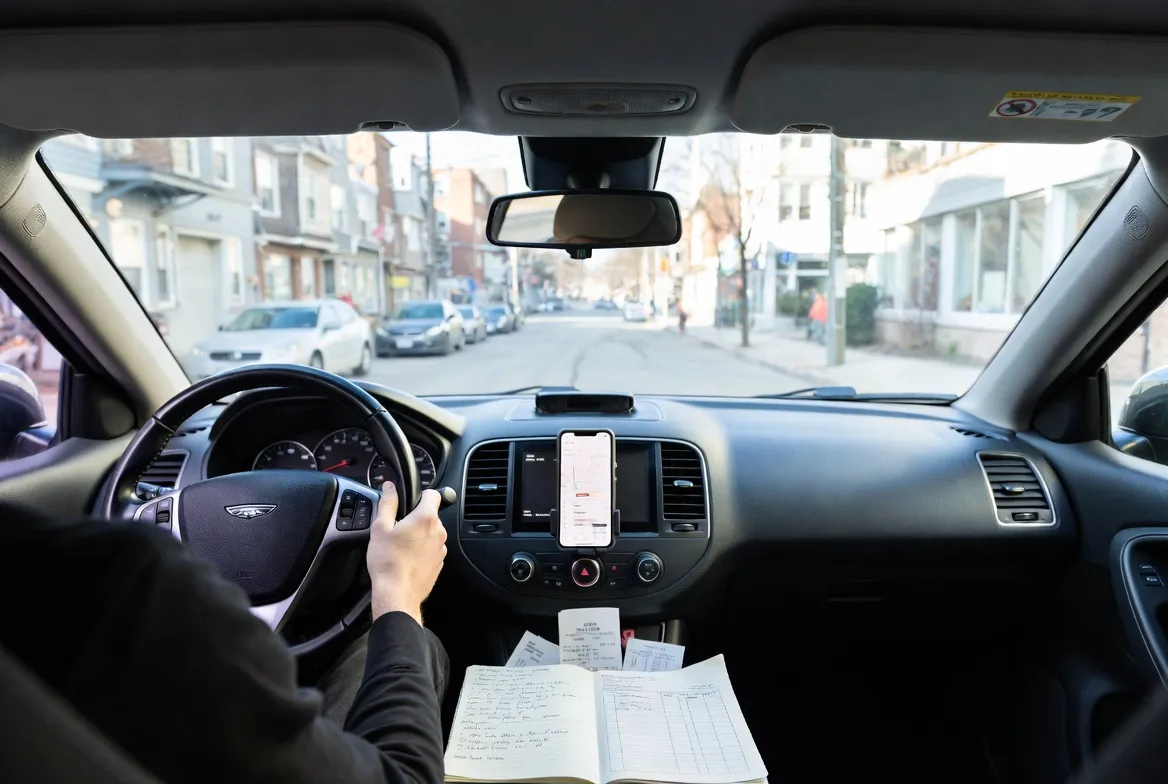
How to track mileage and vehicle expenses correctly as a self-employed worker in Quebec
Simple methods to track mileage and vehicle expenses in Quebec so you can deduct car costs properly as a self-employed worker.