
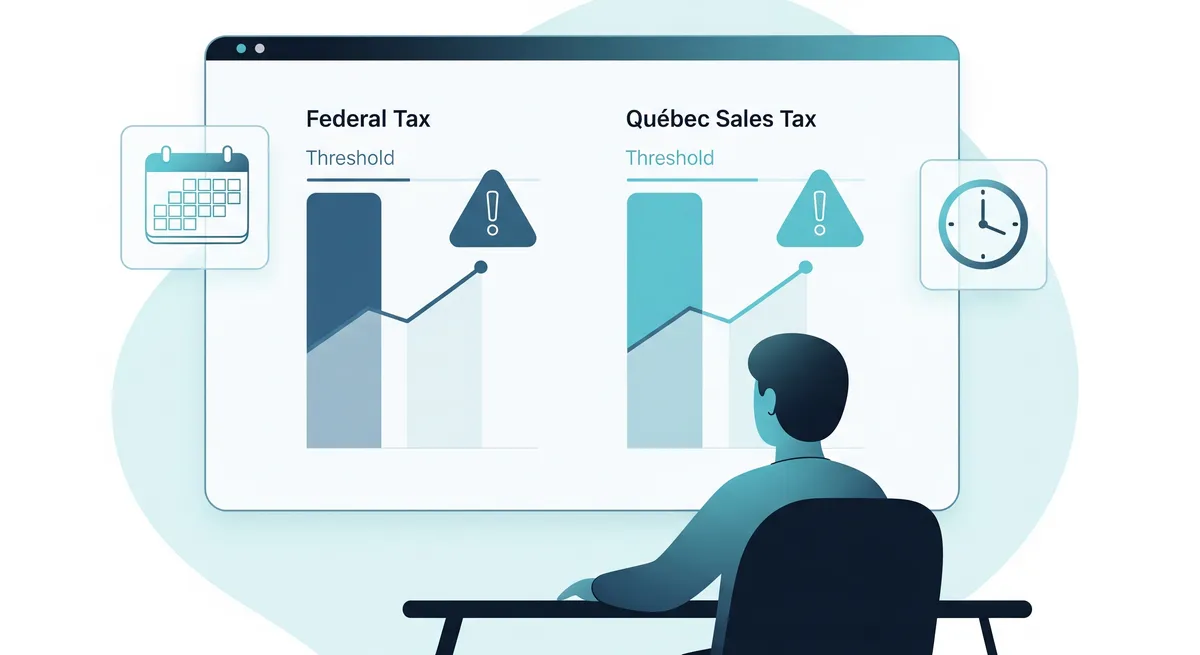
How your Quebec marginal tax rate can affect RRSP tax savings (with examples)
Illustrative examples of how marginal rates can affect RRSP tax savings in Quebec, why a deduction may not produce money back, and what to verify.
Sources: Canada Revenue Agency, Revenu QuébecLast reviewed View sources
Next step
Ready to act on this guide?
Read more articles on this topic, or go to the matching service page when you are ready to act on what you have just read.
Many people hear that "RRSPs give you a big refund," but an RRSP deduction does not mean the final return will show cash back. The deduction can reduce income tax; the amount showing as a refund or balance due also depends on tax already withheld, instalments, credits, benefits, other deductions, and the rest of the return.
The CRA's Line 20800 guidance explains the federal RRSP deduction. Revenu Québec publishes its current provincial brackets. The examples below use assumed combined marginal rates to explain the calculation; they are not current-rate quotes for a particular income.
1. Reminder: how the RRSP deduction works
When you claim an eligible RRSP deduction:
- The amount claimed generally reduces taxable income, subject to your available RRSP deduction limit.
- Tax otherwise calculated on that slice of income may decrease.
- Withdrawals are generally taxable later.
The shortcut “deduction × marginal rate” is only an estimate. A deduction may cross more than one bracket, and interactions with credits or income-tested benefits can change the total result.
2. Illustration using an assumed 30% rate
- Assumed combined marginal rate on the full deduction: 30%.
- RRSP contribution: $2,000.
- Amount claimed as a deduction: $2,000.
Approximate effect:
- Estimated income-tax reduction: $2,000 × 30% = $600.
- That may increase a refund or reduce a balance due by about $600, all else being equal.
This is a teaching example, not a statement that a specific Quebec income has a 30% combined marginal rate.
3. Illustration using an assumed 45% rate
- Assumed combined marginal rate on the full deduction: 45%.
- RRSP contribution: $2,000.
- Amount claimed as a deduction: $2,000.
Approximate effect:
- Estimated income-tax reduction: $2,000 × 45% = $900.
The same deduction produces a larger estimate under the higher assumed rate. In a real return, calculate each part of a deduction in the bracket where it falls rather than applying one rate automatically.
4. Timing your contributions
The article Using RRSP contributions to smooth out high-income years in Quebec explores this idea further. In short:
- A contribution and the deduction claimed for that contribution are related but distinct decisions.
- Subject to the applicable rules and your deduction limit, an unused contribution may be deducted in a later year.
- Compare the expected tax effect, liquidity needs, contribution room, and future withdrawal tax before deciding when to claim a deduction.
5. Using the RRSP refund wisely
Once you receive the RRSP refund, you can:
- Reinvest it (RRSP, TFSA, renovation fund for a plex).
- Pay down high-interest debt.
- Build an emergency fund.
For a broader discussion of how RRSP fits with TFSA and mortgage choices, see:
Need help with your situation?
If you live in Quebec and want to plan RRSP contributions around your marginal tax rate (and your rental or self-employed income), TaxCove can model different scenarios for you. To book a session, start via the secure tax intake form page.
Important notice: This article provides general information only and does not constitute investment or personalized tax advice. The examples use hypothetical rates and omit many tax-return interactions. Verify your deduction limit and current rules with the CRA and Revenu Québec, and obtain advice for material RRSP decisions.
Official sources used in this article
Every rule, date, and threshold in this guide comes from these official sources.
Last reviewed
- CRA Line 20800 — RRSP deduction(opens in a new tab) – Canada Revenue Agency
- Revenu Québec — income tax rates(opens in a new tab) – Revenu Québec
Next step
Need help applying this to your Quebec tax situation?
If this planning question affects your file, contact TaxCove to review the best next step before you file.
Know which return you need? Start online. Not sure yet? Contact us first, no documents needed.
Preparation resource
Quebec tax document checklist
Get the bilingual preparation list by email, then use the secure intake only when you are ready to send tax documents.
Next steps
More guides and services for this topic.
Tax planning
Checklists, RRSP and TFSA trade-offs, and marginal-rate decisions — the planning reads worth doing before you pick a service.
Contact
Contact the Montreal tax and accounting team for Quebec filing support, service-fit questions, and next steps before you submit documents.
Secure online tax filing
Online tax filing across Quebec with bilingual intake, document handling, and clear next steps.
Related articles
More guides and services for this topic.
RRSP vs mortgage repayment vs TFSA: what to prioritize as a Quebec taxpayer?
How to choose between RRSP contributions, paying down your mortgage, and TFSA savings as a Quebec resident, with simple examples.

Using RRSP contributions to smooth out high-income years in Quebec
How to time RRSP deductions for unusually high-income years in Quebec while accounting for future taxable withdrawals.
RRSP vs TFSA timing for Quebec taxpayers: when to contribute each
Strategic timing for RRSP and TFSA contributions if you are a Quebec taxpayer, including how Quebec and federal tax rates affect the optimal choice.